BB
From a content-led travel personality to a bespoke luxury advisory practice that closes at the right tier.
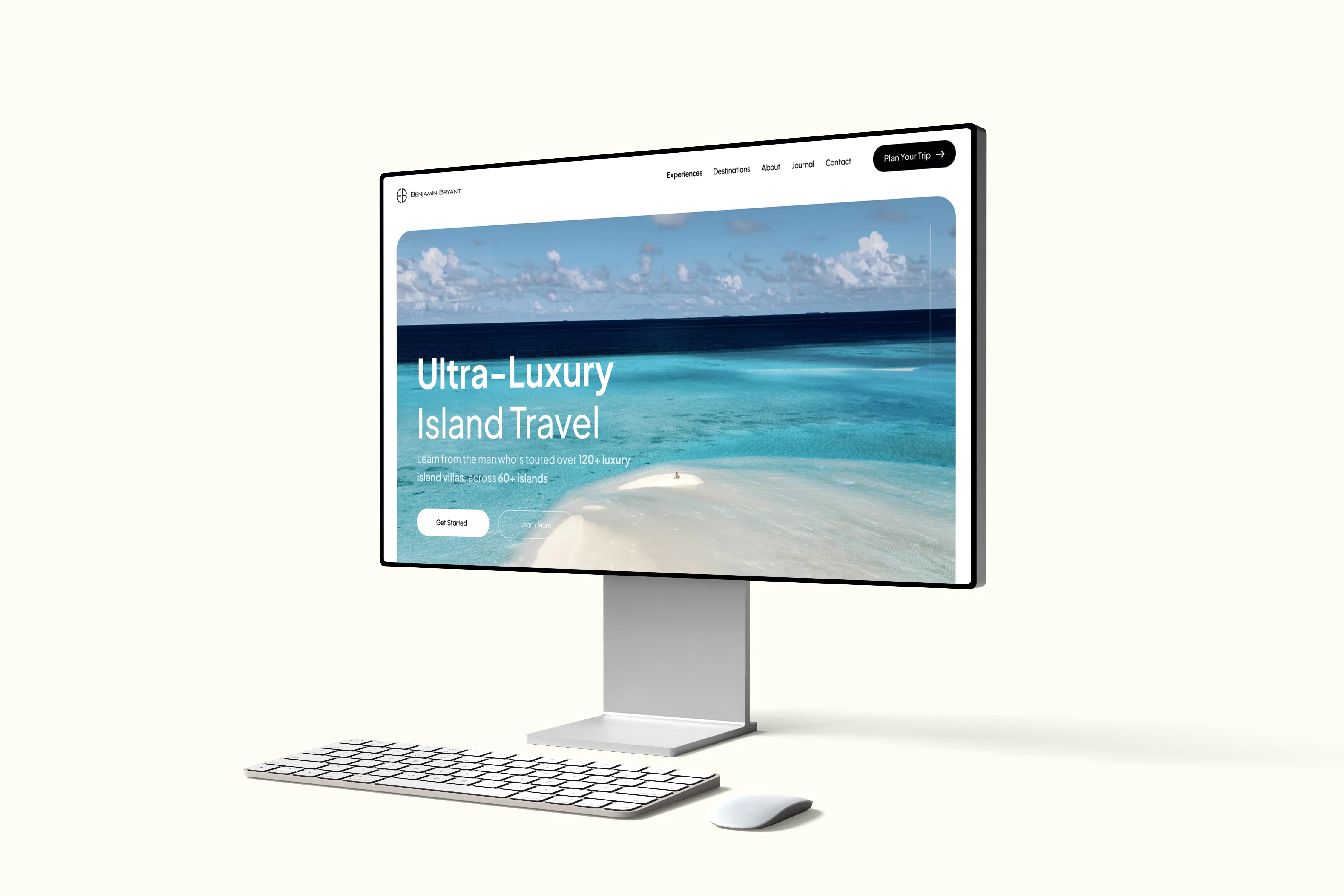
BB had already done the hard part.
Sixty-plus luxury island destinations visited firsthand. One hundred and twenty-plus villas toured, reviewed, and recommended. Speaking engagements at Condé Nast Traveller, World Travel Market London, and the Tourism Society. Over a hundred and fifty million social-media video views, accumulated over years of on-the-ground footage from the Maldives, the Seychelles, and the Indian Ocean's most exclusive resorts.
The credentials were extraordinary. The brand did not match them.
The website led with the visibility (videos, media logos, testimonials) and arrived at the service offering only after a visitor had absorbed the credentials. The pricing was hidden inside the inquiry form. The "An Honest Promise" section that explained the practice's principles sat below everything else, in the page's quietest position.
The brief that arrived was for a redesign. The conversation moved quickly to the deeper question. BB was already operating as a private advisory practice for ultra-high-net-worth travellers. Why was the brand still reading as a high-performing content channel?
Personal-brand luxury travel sits at an awkward edge of the market. The audience-led brands at one end build through visibility and convert through volume. The advisory firms at the other end build through trust and convert through depth. BB had the visibility of the first category and the client-base, pricing tier, and service model of the second. The brand was still operating from the side it had grown out of.
The diagnostic question for any personal-brand engagement is the same. What does this person have that no one else in their category can claim, and is the brand currently communicating it?
Three things were holding it there.
The brand led with content, when it should have been leading with evidence. The site emphasised video features, media appearances, and social-media reach. But they were sitting in the page's content position rather than its evidence position. Evidence goes near the top and is framed explicitly. Content goes lower and is framed as exploration. The old site had its evidence in the content position.
Pricing was hidden where it should have been positioning. A typical Bryant client invests $100,000 or more in a single trip. The figure appeared, but only inside the booking form. For an ultra-luxury advisor, that number is the single most important qualifier.
The personality was foregrounded; the practice was implicit. BB is the brand: the face, the name, the voice. That is correct for a personal advisory practice. But UHNW buyers do not want to feel they are booking with a personality. They want to feel they are engaging a specialist.
The repositioning moved BB out of the content-led travel personality category and into the bespoke luxury advisory practice category.
The shift sat on a single strategic decision. Most luxury travel brands sell access. Bespoke advisors sell discernment.
The answer the work kept returning to: it looks like a specialist's office that happens to have a public face.
Once that decision was made, the rest of the brand resolved itself. The content moved from the foreground to the credentials shelf, the pricing moved from the form to the proposition, and the personal stayed but stopped being the whole of it. The practice that the personal had earned the right to operate became visible for the first time.
A personal brand at the top of the market is not a contradiction. It is a particular kind of architecture, and BB had been operating without it. The same tension between personality and practice appeared in the Instagym engagement, where a founder-led gym needed the brand to signal institution rather than individual.
A full brand architecture, ready to operate at the new tier.
Identity Architecture. The visual register moved from content-creator-style media display to advisory-practice editorial. The BB monogram was kept. Portraits replaced action shots, captions appeared where video play buttons used to live.
Voice and Messaging. The hero copy retained its central claim of ultra-luxury island travel, but stopped trying to prove it through reach. The four named services state what the practice actually does. The footer sign-off "Relax. Recharge. Reconnect." was retained and given quiet visual weight: three words telling the UHNW visitor what an island stay is supposed to deliver. The "An Honest Promise" section moved from the bottom of the page to within the inquiry section.
Service Architecture. Four named services appear at the top of the page, each with a short descriptor. The previous brand structure asked visitors to infer the practice from the content. The new structure states the practice up front and uses the content as proof.
Pricing as Positioning. The pricing disclosure moved out of the booking form and into the proposition itself. Trips start around $4,000 per villa per night, with typical client investment running at $100,000 or more. The line "I don't compete on price" carries the full positioning weight in seven words.
Within twelve months of relaunch, BB had stopped showing up in the same conversation as travel content creators. The brand began appearing alongside Scott Dunn, Pelorus, and Brown + Hudson. 71% of new inquiries were arriving qualified at the $100,000-plus level. Average trip value rose by 38%. Inquiries from referral sources ran at 4.2× their previous rate.
The visitor profile shifted. Time-on-site for new visitors increased, while form completions from the wrong-tier visitors dropped. The page was self-qualifying for the first time.
"The work I do for clients did not change. What changed is that the clients who should have been finding me can now find me, without having to filter through the impression that I'm a content creator who happens to book trips."