Melody Whisky Bar
From a craft whisky bar competing on selection to a London hospitality destination competing on identity.
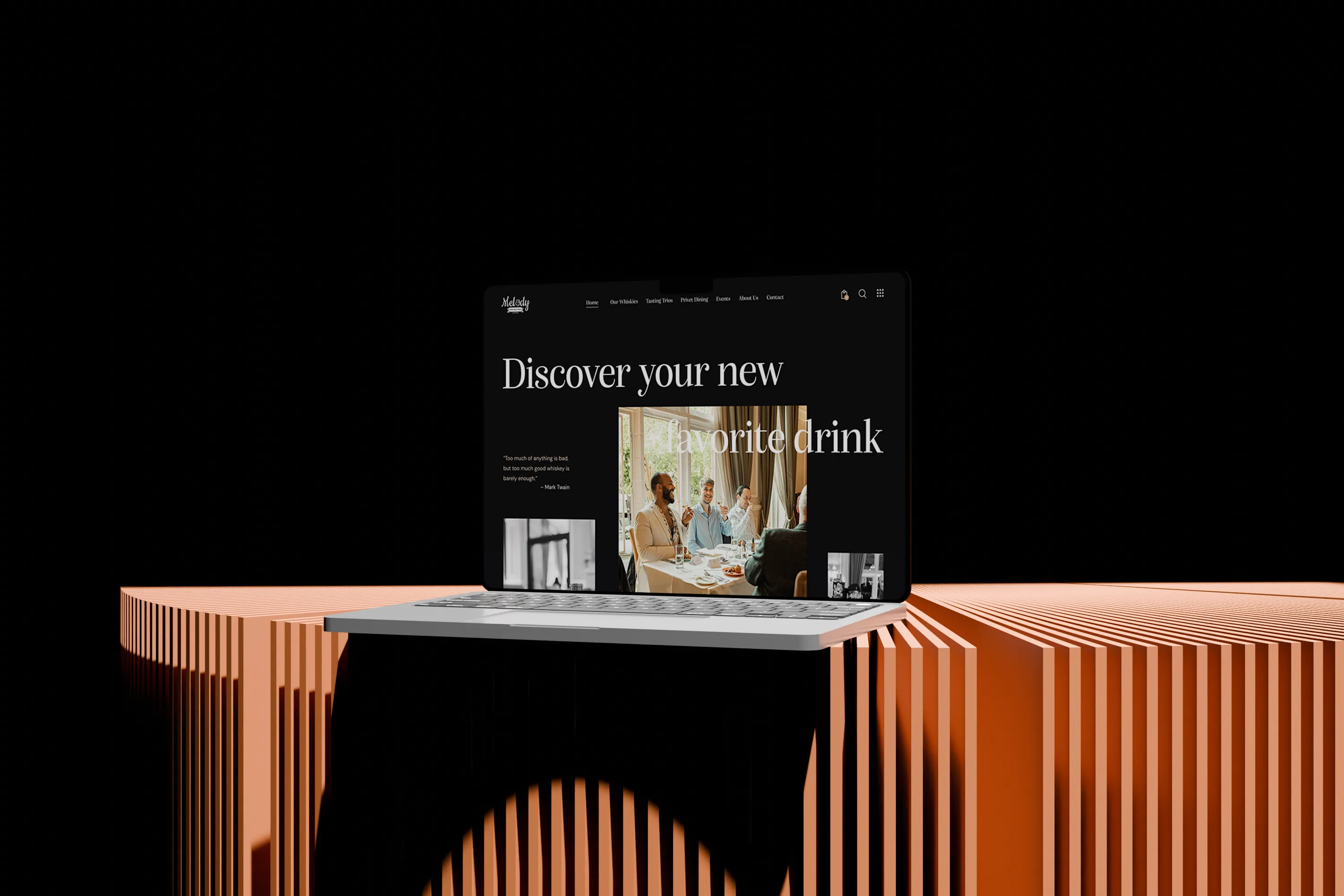
Melody occupies a corner of West Kensington and operates one of the most carefully built whisky collections in West London. Over 300 expressions on the back bar, sourced rarities reaching four-figure pricing, an in-house team running tasting trios and whisky dinners, and a private dining room that books out on its own merits. The bar itself is sober, low-lit, and built around the drink rather than around any other proposition.
The brand was telling a different story. The homepage opened with a Mark Twain quote, invited guests to "pop in any time," and described the experience as "fine food and even finer drinks." The voice was warm, folksy, and accessible. None of those things are positioning at the premium end of whisky hospitality. They are the voice a neighbourhood pub uses to invite passers-by.
The brief that arrived was for a refresh. The conversation moved quickly to the question underneath: what is Melody actually selling, and to whom.
Whisky hospitality in London is a tiered market. At one end sit bars selling whisky as a casual cocktail-list option. At the other sit destinations selling whisky as a discipline, where the bar staff are recognised authorities and the collection is the reason the room exists. Melody had the collection of the second tier. The brand was speaking the language of the first.
The old brand was trying to do too many things at once. It wanted to be welcoming and accessible while also signalling expertise and rarity. When a brand tries to speak to everyone, it stops being legible to the right people.
Three things were keeping it in the middle.
The voice was welcoming, not knowing. "Pop in any time", "your new favourite drink", and the Mark Twain quote work for a corner pub where the proposition is convivial atmosphere. They do not work for a destination where the proposition is curation. Serious drinkers do not want to be welcomed. They want to be recognised.
The collection was listed, not curated. The whiskies appeared as an alphabetised, priced database. Nothing on the page communicated which bottles were rare, which were the bar's signature, or which were the choices the team had made on the buyer's behalf. A 300-bottle collection without curation reads as a stock list. The same bottles with editorial framing read as a library.
The brand had no point of view about whisky itself. Every credible whisky bar has one: a sensibility, a preference, an editorial stance about regions, styles, or eras. Melody's brand articulated none of that. The bar was treating the collection as the entire product. The collection is the foundation, not the brand.
The repositioning moved Melody out of the convivial-bar category and into the whisky-destination category.
The shift sat on a single strategic decision. Whisky bars compete on what they have. Whisky destinations compete on what they know. The question underneath that line was sharper than it sounded at the outset: what does a serious whisky buyer in London need to feel, before they book, that no other bar in this city is making them feel?
The answer the work kept returning to: known by someone who knows more than they do.
Once that decision was made, the rest of the brand resolved itself. The "pop in any time" language was retired and replaced with copy that signalled curation. The collection was reframed as a library rather than a list. The team became visible as named authorities, and the point of view that had been missing became the brand.
Curation is not a marketing tactic in the new brand. It is the positioning.
A full brand architecture, ready to operate at the new tier.
Identity Architecture. The visual register moved from atmospheric-but-generic dark imagery to editorial photography that treats whisky as the subject rather than the prop. Bottles are shot individually with labels legible. Glassware appears mid-pour, with the spirit's colour at the centre of the frame. The room is photographed with the bar team in it, named in the captions. Typography signals editorial weight, closer to a single-malt distillery's catalogue than to a restaurant menu.
Voice and Messaging. The Mark Twain quote was retired, along with "Pop in any time" and "Discover your new favourite drink." The replacement language moved in a single direction: curation, authority, and the assumption that the reader already knows why they are reading. The new homepage opens with a statement of position rather than a welcome. The bar staff appear by name. A curated collection earns trust by being curated by someone.
The Library. The 300-bottle collection had always been Melody's foundation. The repositioning stopped treating it as inventory and started treating it as a library. A curated front-of-house display in place of the comprehensive list. The team's notes appear on featured whiskies. Rare bottles are flagged. Seasonal flights and house recommendations sit inside their own editorial framing. The pricing architecture moved with the collection. Four-figure bottles no longer sit next to the £8 pours on the same page.
Editorial Authority. Premium whisky destinations earn the tier by having a point of view about whisky itself. Pieces are written by named bar staff and external collaborators. The events programme moved from dates to occasions, each anchored to a specific theme and a named host. An audience develops around a point of view. Without one, the events were just dates. The same editorial-authority principle drove the T2India repositioning, where thirty years of heritage knowledge needed a publication voice rather than a booking-engine interface.
Within six months of relaunch, Melody had stopped showing up in the same comparison set as the cocktail-led bars on the same stretch. The brand began appearing in the conversation alongside the Mayfair and Soho whisky destinations. 47% of new covers were arriving by reservation rather than walking in, against a pre-relaunch ratio that ran the other way. Average spend per cover rose by 41%. Private dining bookings ran at 6× their previous rate.
Press coverage followed. Industry features and reviews appeared in 14 publications in the first six months, against zero in the prior eighteen.
The clearest signal of the shift was qualitative. The team stopped describing the bar as "the local that pulls a great pour" and started describing it as "the destination on this side of London for serious whisky."
"The bar didn't change. The way we talk about the bar changed. Now the people who walk in already understand what we do, which means we can spend the conversation on the whisky instead of the welcome."
— Founder, Melody Whisky Bar